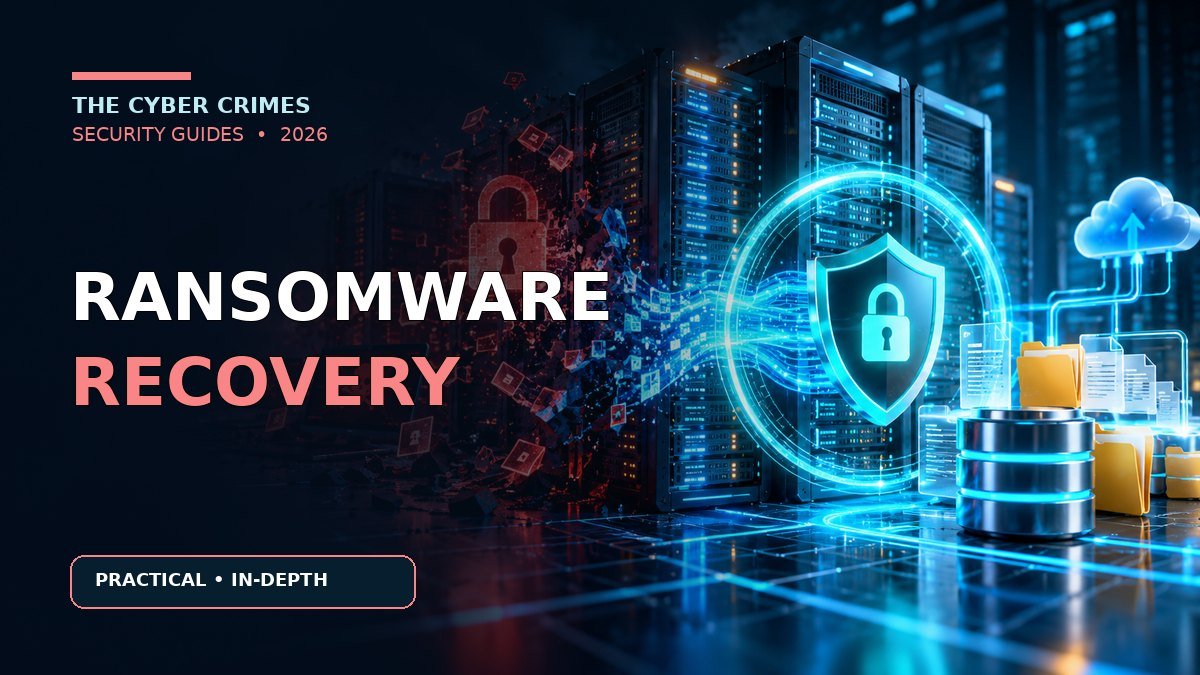
Ransomware Recovery Costs: Downtime, Backups, Insurance and Business Planning
CYBERSECURITY EXPLAINER · THE CYBER CRIMES
Ransomware does more than display a demand on a screen. It can interrupt operations, force employees to use manual workarounds and create uncertainty about whether data was copied. Recovery costs are highly dependent on the systems affected and the quality of preparation. The most useful budget is therefore built from business dependencies and realistic restoration exercises, not a single dramatic industry-wide figure.
The practical goal of this guide is to make a real decision easier. It explains how the category works, what buyers or operators should verify, and where a misleading promise can create risk. Examples are illustrative rather than forecasts, quotes, legal advice or endorsements. Availability and requirements may change by country, provider, organization size and contract terms.
The true cost of ransomware includes downtime, specialist assistance, rebuilding systems, lost productivity and possible legal obligations. A reliable plan focuses on containment, evidence preservation and verified restoration—not paying attackers.
Why ransomware recovery costs Matters in Real Life
Before selecting a provider or changing a process, define the business outcome you are protecting. An organization should know who owns the relevant accounts and data, which activities would stop during an incident, and what evidence is available to assess whether a control is working. This avoids measuring security by the number of subscriptions purchased. A useful written plan can be maintained by a small team and reviewed after meaningful changes.
For business owners, operations leaders and IT managers preparing for ransomware disruption, the important question is how to estimate operational recovery exposure and prepare responsible decisions during an incident. Good decisions acknowledge uncertainty and use realistic examples instead of promises of perfect safety. A plan should remain readable for staff who are not cybersecurity specialists, because they are often the first people who notice a problem.
Direct technical recovery expenses
Incident responders may need to investigate entry points, isolate affected systems, collect evidence, rebuild infrastructure and validate that malicious access has ended. Internal staff time is also a cost, even when no outside invoice is issued.
Practical example: direct technical recovery expenses
A small manufacturing company may have to rebuild a scheduling server and verify machines before production resumes. The work may require both IT help and staff who understand the production process.
What to verify: Document the minimum technical evidence and recovery tasks your business would require before declaring systems operational. Record who can answer the question and what evidence supports the conclusion. This makes the decision easier to audit and explain later.
Downtime and lost operational capacity
Downtime has different financial effects across businesses: halted sales, delayed shipments, missed appointments and additional manual work. Estimating cost by average daily revenue alone can be misleading because some delayed work may later be recovered.
Practical example: downtime and lost operational capacity
A booking platform may reschedule appointments, while a time-sensitive delivery company might permanently lose revenue for missed service windows. A cost estimate should distinguish these outcomes.
What to verify: For each critical service, record maximum tolerable downtime and which transactions can realistically be recovered afterward. Record who can answer the question and what evidence supports the conclusion. This makes the decision easier to audit and explain later.
Backup architecture and restoration testing
Protected, offline or immutable backups can limit dependence on attacker-controlled recovery options. However, a backup may still be unusable if credentials, dependencies or applications are missing. Test restoration using the tools and staff available during a real incident.
Practical example: backup architecture and restoration testing
An organization discovers that data files can be restored but the application version required to read them is no longer available. Testing whole workflows catches this problem sooner.
What to verify: Confirm backup separation, restoration permissions, data integrity and the time taken to recover a usable business process. Record who can answer the question and what evidence supports the conclusion. This makes the decision easier to audit and explain later.
Legal notification and investigation requirements
Some incidents involve personal data exposure, regulatory reporting or contractual notice obligations. Rules depend on affected people, jurisdiction and industry; not every ransomware event creates the same notification duty. Counsel and qualified responders can help identify what facts must be established.
Practical example: legal notification and investigation requirements
A company operating in several countries may need to determine whose personal records were affected before evaluating specific deadlines. Public guesses can make the situation worse.
What to verify: Prepare a contact list for legal counsel, incident response, insurers and any relevant reporting channels before an incident. Record who can answer the question and what evidence supports the conclusion. This makes the decision easier to audit and explain later.
Insurance coverage and claims documentation
Cyber insurance may assist with eligible forensic, recovery, liability or interruption costs, but policy details matter. Keep contemporaneous incident notes, vendor invoices and approvals. Contact insurers as required before making expenses that may need consent.
Practical example: insurance coverage and claims documentation
An IT vendor is hired overnight without notifying the carrier, then the owner learns that some expenses required prior approval. Knowing the policy’s emergency process can reduce uncertainty.
What to verify: Place the policy incident number and retention requirements in the same secured response kit as other emergency contacts. Record who can answer the question and what evidence supports the conclusion. This makes the decision easier to audit and explain later.
Extortion pressure and safe decision-making
Attackers may threaten publication, threaten further disruption or impose artificial deadlines. Ransom payments do not guarantee a working decryptor or deletion of stolen information; they can also raise legal sanctions questions. Decisions should involve qualified responders, counsel and appropriate authorities.
Practical example: extortion pressure and safe decision-making
An attacker claims that all copies of data will be erased if a payment arrives within twelve hours. The claim cannot be independently treated as proof of deletion or full recovery.
What to verify: Separate operational restoration decisions from attacker messaging and avoid promises based only on criminal statements. Record who can answer the question and what evidence supports the conclusion. This makes the decision easier to audit and explain later.
Rebuilding trust after systems return
Recovery continues after basic services work. Organizations may need to rotate credentials, inspect endpoints, review supplier access, strengthen monitoring and communicate confirmed facts. Restarting an unchanged environment risks repeating the event.
Practical example: rebuilding trust after systems return
A restored email server appears functional, but compromised forwarding rules still redirect invoices. A post-recovery validation checklist identifies leftover unauthorized changes.
What to verify: Define what evidence must be reviewed before credentials, customer access and automated transfers are re-enabled. Record who can answer the question and what evidence supports the conclusion. This makes the decision easier to audit and explain later.
Ransomware Recovery Costs: Comparison Table
Use the table below as a discussion aid. These are decision criteria rather than a universal product ranking. Exact features and obligations must be confirmed for your organization, location and contract.
| Decision area | Basic approach | Stronger approach |
|---|---|---|
| Downtime estimate | One average revenue figure | System-by-system impact and recoverable work |
| Recovery readiness | Backup exists on paper | Entire workflow actually restored |
| Response spending | Untracked emergency purchases | Pre-approved vendors and records |
| Ransom decision | Assume payment fixes everything | Independent legal and technical response |
| Data exposure | Assume only files encrypted | Investigate possible unauthorized access |
| Insurance | Assume all losses covered | Notification conditions and sublimits verified |
| Return to service | System boots | Credentials and integrations validated |
Example Decision: Ransomware Recovery Costs in a Realistic Scenario
A regional services company lists its four essential systems and practices two restoration exercises. Its finance manager separates fixed daily operating costs from revenue likely to be recovered after downtime. The response team prepares an escalation list and identifies which specialists would be needed. When the business reviews cyber insurance options, it uses this measured dependency list rather than a generic cost statistic. This creates a financial plan that can be updated after each backup test.
This illustration is intended to show the questions an organization can ask, not to predict an incident, an insurance claim or an outcome. Each business should adapt the decision to its own country, systems, users and obligations.
Step-by-Step Plan for Ransomware Recovery Costs
Step 1: Write down your specific objective and the business impact of failure
Describe what success means in language leadership and staff can understand. Include the affected process, the people who rely on it and what could go wrong. A clear objective prevents expensive features from distracting the project.
Step 2: Inventory users, services, data, contracts and decision owners
Capture which systems and identities the decision affects. For purchases, include renewal and contract responsibilities; for internal practices, record who operates and tests them. Missing ownership causes preventable failure.
Step 3: Identify the most likely gap using actual evidence rather than a guess
Gather concrete observations: a configuration screenshot, sample report, test result, policy document or support response. Separate an assumed risk from a verified weakness and record remaining uncertainty.
Step 4: Compare at least two practical approaches on the same criteria
Use an identical decision worksheet for each option. Compare capability, ongoing labor, support and exclusions or limitations where relevant. Avoid assigning a winner based only on the cheapest advertised starting price.
Step 5: Pilot the proposed control with a realistic scenario
Test an everyday workflow and an abnormal one. Ask users whether the process is workable and check logs, communications and response times. A pilot should uncover a real limitation before wide adoption.
Step 6: Document ownership, emergency contacts and a future review date
Record a control owner, a backup contact and the next review date. Preserve appropriate evidence of changes. Repeat the review after incidents, major staffing changes or substantial new software.
Five Common Mistakes to Avoid
Treating a headline claim as complete protection
Every technology, contract and checklist has boundaries. Read what is actually provided, which responsibilities remain yours, and what happens when a normal assumption fails.
Choosing a product before defining a workflow
Start with a real operational problem and the people who must respond. A feature without an assigned owner can provide less value than a simple, consistently practiced procedure.
Ignoring configuration and employee turnover
Security depends on day-to-day administration. Review shared accounts, external access and emergency credentials after organizational changes rather than assuming the original setup remains correct.
Skipping tests and written evidence
An unchecked backup, untested reporting route or unused response process can fail at the first emergency. Keep dated results from small, repeatable exercises.
Assuming all rules and prices are universal
Insurance terms, legal duties, available security features and fees depend on jurisdiction, contract and use case. Verify the exact arrangement instead of importing a claim from another country.
Frequently Asked Questions About Ransomware Recovery Costs
Is ransomware recovery costs worth considering for a very small organization?
It can be useful when a specific risk, workload or operational gap justifies the time and cost. Start by identifying the problem and checking whether a simpler control already addresses it. The right answer depends on existing arrangements, staff capacity and the value of what needs protection.
What should I compare before buying or changing ransomware recovery costs?
Compare actual scope, limitations, administrative effort, response responsibilities, support availability and what happens during a failure. Ask for a written demonstration or worked example. Marketing feature lists are not substitutes for a tested process or the full applicable terms.
Does ransomware recovery costs guarantee protection from cybercrime?
No. Security risks can be reduced but not eliminated, and one service or practice cannot prevent every possible incident. Treat any protection as one part of a wider plan involving identity controls, updates, backups, monitoring and response.
How frequently should I review my ransomware recovery costs decisions?
Review after a meaningful change in systems, business operations, staffing, threats or contract terms. A scheduled review helps, but an incident or major migration may justify an earlier check. Record decisions and responsible owners so the review leads to action.
Can I use free resources before choosing ransomware recovery costs?
Yes. Public guidance from organizations such as NIST, the FTC and CISA can help build a baseline. Free steps like MFA, careful access reviews and tested backups may offer immediate value. A paid service should solve a clearly identified need beyond those basics.
Final Takeaway
The best approach to ransomware recovery costs is the one that supports an important business or personal need, has clearly understood limits, and remains workable after the initial setup. Use written comparisons, relevant testing and independent sources to avoid rushing into a product or assuming every risk is covered.
For related awareness checks, explore the free Cyber Safety Analyzer. It is a browser-based educational tool, not a live malware scan or a substitute for a professional assessment.
Sources and Further Reading
These resources provide background guidance. Product terms, country-specific rules and incident facts should be verified independently.